
Chase Manhattan Bank Building (New York, N.Y.
Enlarge text Shrink text-
 Corporate Body

-
Save successfulThe item can be found in your Personal ZoneשגיאהLog in to your account to save

- (Former) Manufacturers Trust Company Building (now Chase Bank Building), 1997:p. 1 (Manufacturers Trust Company Building; loc. at 510 Fith Avenue and 2 West 43rd Street, Borough of Manhattan; built 1953-54; architects Skidmore, Owings & Merrill) p. 8 (Manufacturers Hanover Trust Company; merger in 1961 with Hanover Bank; later merged with Chemical Bank; subsequently merged with Chase Manhattan Bank which was renamed Chase Bank in 1996)
- AIA guide to New York City, 1988:p. 240 (Manufacturers Hanover Trust Company branch; originally Manufacturers Trust Company)
- Phone call to Ronald Mayer, Senior Vice President, Chase Manhattan Bank, Legal Dept., Jan. 6, 1998(correct name for the company is Chase Manhattan Bank; a merger with Chemical Bank occurred July 14, 1996)
- New York State Banking Dept., Institutional History of Banks WWW Home page, Jan. 6, 1998(Manufacturers Trust Company; Sept. 8, 1961 acquire by merger Hanover Bank; Sept. 8, 1961 name change to Manufacturers Hanover Trust Co.; June 30, 1976 acquire by merger Manufacturers Hanover Trust Co./Mid-Hudson; June 30, 1976 acquire by merger Manufacturers Hanover Trust Co./Suffolk; Dec. 31, 1985 acquire by merger Manufacturers Hanover Trust Co., National Association; June 19, 1992 merger to state Chemical Bank; July 14, 1996 name change to Chase Manhattan Bank, The)


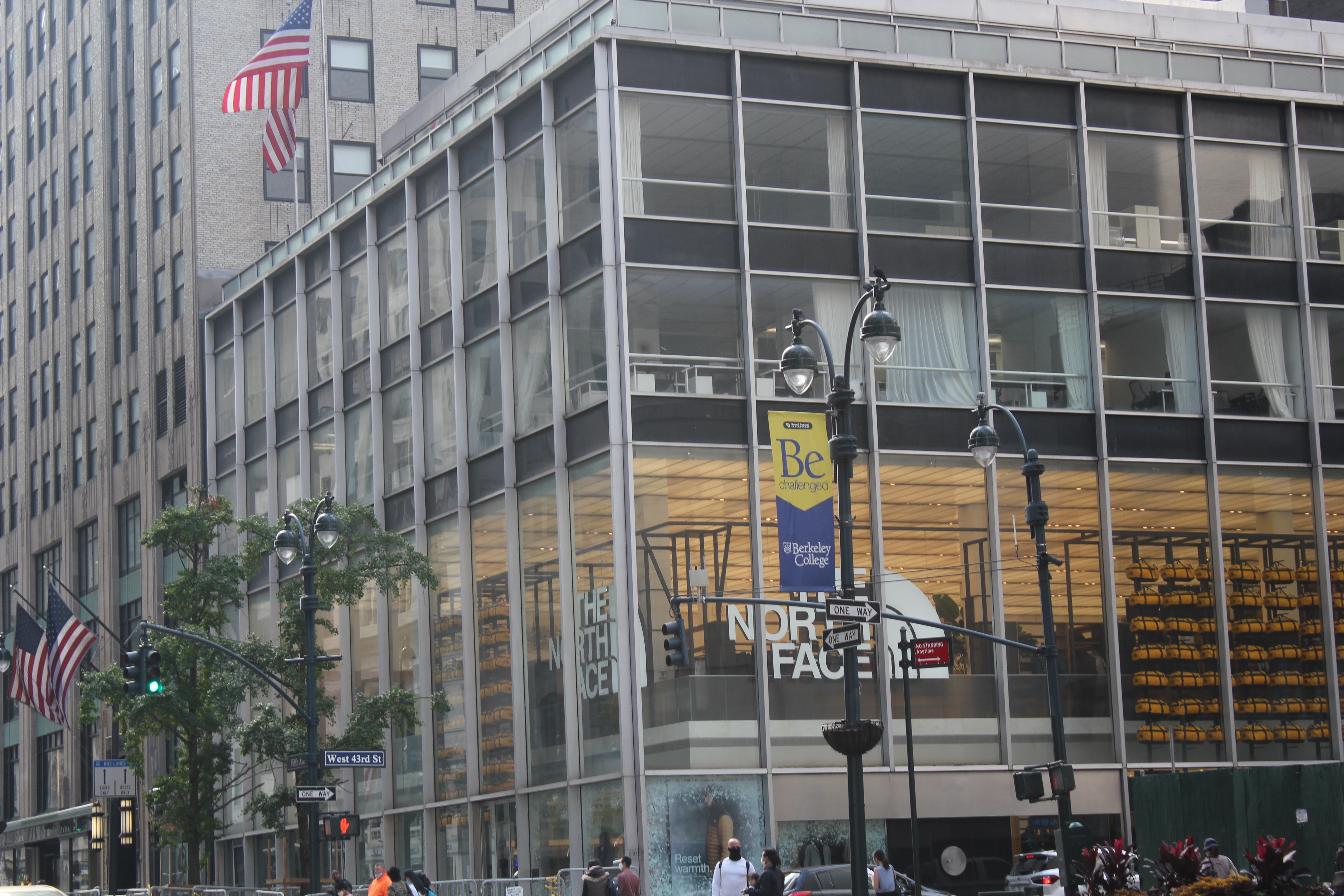


The Manufacturers Trust Company Building, also known as 510 Fifth Avenue, is a commercial building at the southwest corner of West 43rd Street and Fifth Avenue in Midtown Manhattan, New York City. Opened in 1954, it is the first bank building in the United States to be built in the International Style. Charles Evans Hughes III and Gordon Bunshaft of Skidmore, Owings & Merrill (SOM) designed the building, along with Roy O. Allen and project manager Patricia W. Swan. Eleanor H. Le Maire designed the interior, and Harry Bertoia was the artist for some of the building's artwork. 510 Fifth Avenue was built as a bank for the Manufacturers Trust Company, whose president Horace C. Flanigan wanted the design to be inviting to customers. The Manufacturers Trust Company Building contains four full stories, a penthouse, and a basement. Its facade is made largely of glass walls between mullions made of aluminum. Inside is a circular stainless steel door protecting the original bank vault, which was designed by Henry Dreyfuss. The second story is recessed from the facade, and the floor slabs of the upper stories are carried on four columns, giving the impression that they are floating. The building's height and design was influenced by a lease restriction that prohibited the construction of a taller building on a portion of the site. A smaller penthouse rises above the fourth story. The building was commissioned by Manufacturers Trust in 1944; the original plan was designed by Walker & Gillette and canceled in 1948. Walker & Poor was hired in 1950 to modify the original proposal but were replaced with consulting architect SOM after Bunshaft convinced bank executives that a complete redesign would be cheaper. The building was instantly popular upon its opening, becoming Manufacturers Trust's busiest branch and a tourist attraction in itself. Manufacturers Trust's successor, Chase Bank, sold the building to Tahl-Propp Equities in 2000, and it was purchased by Vornado Realty Trust in 2010. After the Chase branch closed in late 2010, SOM renovated 510 Fifth Avenue and converted it into a commercial structure in 2012. Reuben Brothers bought the building in 2023. The design received critical acclaim upon its completion. Praise was focused particularly on its lightweight facade, ceiling lighting, and visible vault. The design inspired that of other bank buildings erected in the 1950s and 1960s. The building's facade was designated as an official landmark by the New York City Landmarks Preservation Commission (LPC) in 1997, and its interior was similarly designated in 2011, following controversy over the removal of one of Bertoia's artworks.
Read more on Wikipedia >