
Deori language
Enlarge text Shrink text-
 Topic
Topic

-
Save successfulThe item can be found in your Personal ZoneשגיאהLog in to your account to save

- Brown, W.B. An outline grammar of the Deori Chutiya language, 1895.
- Klose, A. Sprachen der Welt, 1987(Chutiya, Deori Chutiya, Chutia, Deori)
- Ethnologue:under India (Deori (Chutiya, Deuri, Drori))
- Ethnologue 15, Feb. 7, 2008(Deori; language of india; variants: Chutiya, Deuri, Dewri, Drori, Dari; may constitute its own subgroup under Bodo-Garo)
- Email from Dr. F. Jacquesson, Researcher at Centre Nationale de la Recherche Scientifique, Jan. 24, 2008(Deori; traditional spelling; Deoris are the only group that speak the Deori language)
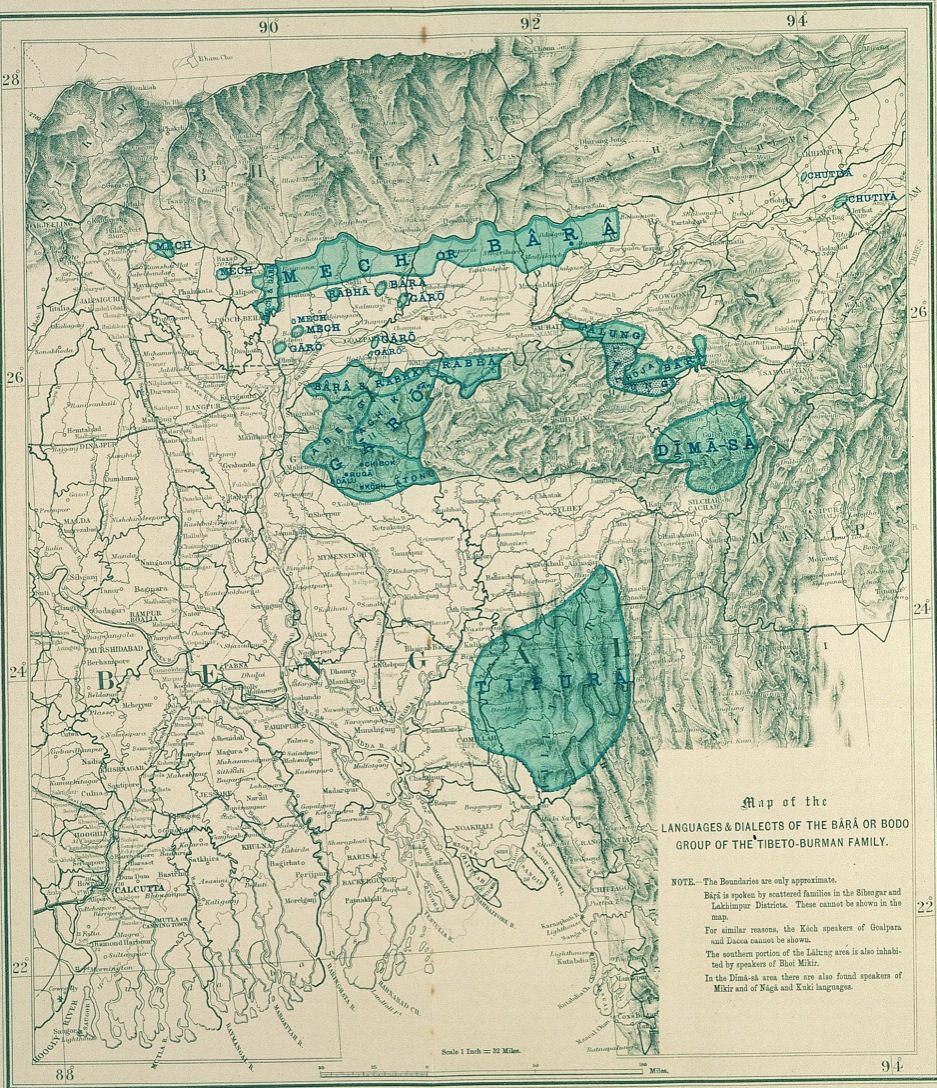
Compiled and Edited by G.A. Grierson, C.I.E, PH.D., D.Litt., I.C.S.
Office of the Superintendant, Government Printing, India 1903, Public domainDeori (also Deuri) is a Tibeto-Burman language in the Tibeto-Burman languages family spoken by the Deori people of Assam and Arunachal Pradesh. Deori are also a part of Bodo–Kachari people. Among the four territorial groups only the Dibongiya have retained the language. The others—Patorgoyan, Tengaponiya, and Borgoyan—have shifted to Assamese. It is spoken in Lohit district of Arunachal Pradesh, and in Lakhimpur, Dhemaji, Tinsukia, Sivasagar and Jorhat districts of Assam. The primary literary body of Deori is known as "deori chucheba chengcha" (Deori Sahitya Sabha). In the colonial times this language became associated with the Chutia people erroneously, and came to be known as the "Chutia language" in the Linguistic Survey of India. Modern scholarship do not associate the Deori language with the Chutia community. The Deori language is one of the most influential languages which has helped develop the Assamese language in Upper Assam. However, the word for water has a similar form in many other languages of the Sal branch of Sino-Tibetan to which Deori belongs, so it is not conclusive evidence that Deori speakers were the first to occupy this area.
Read more on Wikipedia >