
Callistus III, Pope, 1378-1458
Enlarge text Shrink text-
 Personality

-
Save successfulThe item can be found in your Personal ZoneשגיאהLog in to your account to save

- Badajoz, L.G.A. A la sombra de un destino, 1987:p. 4 of cover (Alonso de Borja y Martí; b. 1378, Játiva, Valencia [Spain]; Borgia; Alonso de Borja) p. 4 of plates (Alonso de Borja, Papa Calixto III) p. 9 of plates (d. 1458)
- New Cath. ency., 1967(Callistus III, Pope; pontificate 4-8-1455 to 8-6-1458; b. Alfonso de Borgia, 12-31-1378; d. Rome, Italy)
- LC data base, 11-05-87(hdg.: Calixtus III, Pope, 1378-1458)
- Annuario pontificio 1987:p. 21 (Callisto III)
- Ency. Brit.(Calixtus III)
- Ency. Amer.(Callistus III; Alonso Borgia; b. 1-13-1378; d. 8-6-1458)
- Westminster dict. of church hist., 1971(Callistus III)




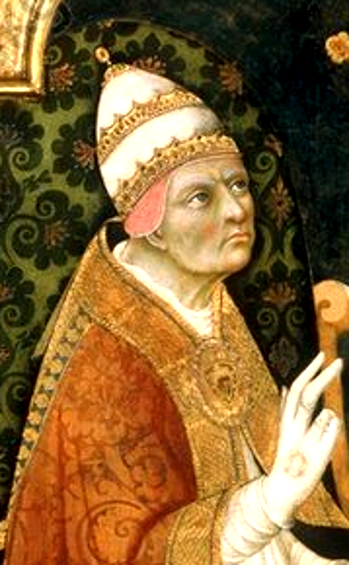

Pope Callixtus III (Italian: Callisto III, Valencian: Calixt III, Spanish: Calixto III; 31 December 1378 – 6 August 1458), born Alonso de Borja, but referred to in English-language accounts as Alfonso de Borgia as a member of the House of Borgia, was head of the Catholic Church and ruler of the Papal States from 8 April 1455 to his death, in August 1458. Borgia spent his early career as a professor of law at the University of Lleida; he later served as a diplomat for the kings of Aragon. He became a tutor for King Alfonso V's illegitimate son Ferdinand. After arranging a reconciliation between Alfonso and Pope Martin V, Borgia was made Bishop of Valencia. In 1444, Pope Eugene IV named him a cardinal, and Borgia became a member of the Roman Curia. During the siege of Belgrade (1456), Callixtus initiated the custom that bells be rung at midday to remind the faithful to pray for the crusaders. The tradition of the Angelus noon bell still exists in most Catholic churches to this day. He was also responsible for the retrial of Joan of Arc that saw her vindicated. He appointed two nephews as cardinals, one of whom became Pope Alexander VI. He is the last pope to date to take on the pontifical name "Callixtus".
Read more on Wikipedia >